AntiqID

AntiqID

Every antique has a story. Discover what it's really worth.

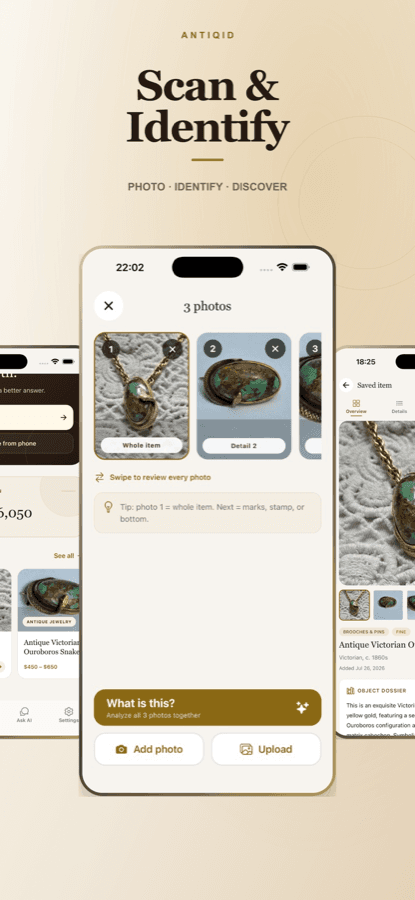
Snap photos of full pieces, hidden maker marks, and joinery. AntiqID verifies tariff dates, decodes hallmarks, detects reproductions, and calculates realistic resale ranges.

Download for iPhone

Available on the App Store

See how it works
  • 15,000+ hallmarks & backstamps
  • Historical tariff & dovetail dating
  • Completed sold comps — not asking prices
  • 100% private on-device collection
AntiqID scan and identify screen

15,000+

Hallmarks & makers' marks decoded

1891–1952

Tariff & origin dating rules

4-Angle

Forensic scan per object

100% Private

On-device collection storage

Why Choose AntiqID

The AntiqID Difference vs. Generic Antique Apps

Most apps give you superficial guesses and trap you with expensive subscriptions. AntiqID is built with professional appraisal standards, verified hallmark databases, and complete privacy.

AntiqIDAntiqID App
Appraiser Grade
  • Forensic Identification Engine

    Multi-angle analysis matching 15,000+ hallmarks, maker stamps, tariff laws (1891–1952), and wood joinery.

  • Valuation & Pricing Accuracy

    Grounded Fair Market Value ranges calculated from completed, verified auction records with cited sources.

  • Silver Hallmarks & Porcelain Marks

    Dedicated assay office & maker database (Lion Passant, assay cities, date letters, Meissen slash marks).

  • Privacy & Data Ownership

    100% on-device private catalog. No mandatory account creation, zero tracking of your valuable assets.

  • Interactive Expert Assistant

    Conversational Ask AI grounded with live Google Search, historical archives, and gentle patina care tips.

  • Transparency & Confidence

    Honest confidence meter explaining missing evidence and indicating the exact angle needed to confirm maker.

Other AppsGeneric Identifier Apps
Common Pain Points
  • Forensic Identification Engine

    Generic image classification that guesses broad tags ('vase', 'silver item') without hallmark confirmation.

  • Valuation & Pricing Accuracy

    Inflated active eBay asking prices or ungrounded AI guesses that lead to costly buying/selling mistakes.

  • Silver Hallmarks & Porcelain Marks

    No hallmark database — fails to distinguish solid sterling silver from $25 electroplated nickel (EPNS).

  • Privacy & Data Ownership

    Requires account sign-up, tracks user collections on remote cloud servers, and monetizes personal data.

  • Interactive Expert Assistant

    Static, one-time result card with no follow-up questions or conservation advice.

  • Transparency & Confidence

    Black-box guessing with zero explanation of why a result was selected or whether it might be a reproduction.

The Risk: Relying on unverified generic image apps can lead to buying reproductions or selling family heirlooms far below market value.

Engineered for collectors, estate sale flippers, and curious owners who need verified facts rather than expensive guesswork.

The Appraiser's Methodology

The 5-Step Forensic Hierarchy Used by Professional Appraisers

Amateurs start with decorative style—which is the easiest trait to fake. Certified appraisers follow a strict forensic order of physical evidence before guessing an era.

01Primary Evidence

Physical Maker's Marks & Signatures

Undersides, drawer backs, inner rims, and clasps

Always start with a flip. Porcelain backstamps, silver assay punches, and foundry stamps reveal the maker and registered workshop instantly.

02Regulatory Stamp

Country-of-Origin & Tariff Markings

McKinley Tariff Act (1891) to Occupied Japan (1945–1952)

Country alone ('Bavaria', 'France') means 1891–1914. 'Made in' means post-1914. 'Occupied Japan' locks production to an exact 7-year window.

03Structural Proof

Forensic Joinery & Tool Marks

Hand dovetails, Knapp pin-and-cove, and pontil scars

Hand-cut dovetails (pre-1870) show uneven chisel marks. Circular Knapp joints date precisely to 1870–1900. Machine cuts dominate after 1890.

04Material Chemistry

Precious Metals & Chemical Tests

Sterling .925 vs EPNS plate, 365nm UV glow, Bakelite aroma

A British Lion Passant confirms solid .925 silver. 365nm UV light detects uranium oxide glass (1880–1930s) and reveals invisible ceramic repairs.

05Contextual Clue

Decorative Period & Style

Chippendale, Victorian, Art Nouveau, Mid-Century Modern

Style is evaluated last because every popular design era was mass-reproduced. Physical construction always overrides decorative appearance.

Understanding Real Value

The 3 Types of Value (Why Pricing Confuses Most Sellers)

An antique does not have one single price tag. Professional appraisal societies (ISA, ASA) distinguish three distinct market tiers depending on your objective.

Fair Market Value (FMV)

100% Baseline

Estate sales, private resale, tax deductions & divorce

The price agreed upon by a willing buyer and willing seller on the open secondary market, with neither party forced to transact and both possessing reasonable facts.

Rule: This is the realistic net cash value you should expect when selling online or at high-end estate sales.

Retail Replacement Value

150% – 250% of FMV

Insurance policies & loss coverage

The total cost required to replace an item with an identical piece from a gallery or premier dealer within 30 days, including retail overhead, framing, and sales tax.

Rule: Never mistake an insurance replacement appraisal for what you will receive in cash when reselling.

Liquidation / Auction Value

30% – 50% of FMV

Immediate estate clear-outs & pawn cash

The fast cash realized when an item must be sold under tight time constraints, typical of whole-house estate liquidations or wholesale dealer buy-ins.

Rule: Dealers buy at liquidation pricing to allow room for overhead, restoration, and resale margins.

The Active Listing Trap: Asking Prices vs Completed Sold Comps

Amateur sellers often look at eBay active listings where someone asks $750 for an item that has sat unsold for months. AntiqID evaluates completed, verified auction and sold database records where real buyers actually paid real money (e.g. $85).

Real Estate Sale Case Studies

True Collector Stories: Hidden Gems, Fakes & Costly Mistakes

Learn from real-world appraisal discoveries and cautionary tales from auction floors and estate sales across the United States.

Porcelain Inspection

The $10 Thrift Store Meissen Plate with the Crossed Swords

The Find: A collector bought a porcelain plate at a suburban yard sale for $10, noticing the iconic blue crossed-swords Meissen mark.

The Forensic Check: Under raking light, an appraiser spotted two deep wheel-cut slash marks directly across the blue underglaze crossed swords.

Value settled at $65 instead of $850.

Meissen factory inspectors scored intentional slashes across the mark to designate 'factory seconds' with porcelain or glaze flaws, reducing market value by 70%.
Furniture Restoration

The Cleaned $12,000 Patina Tragedy

The Find: Heirs inherited an untouched 1780s American cherrywood chest with dark, naturally oxidized original finish and decided to strip it to 'make it look brand new.'

The Forensic Check: The aggressive stripping and modern polyurethane coating destroyed over 200 years of irreplaceable amber oxidation and tool marks.

Market value plummeted from $12,000 to $2,500.

Appraisers live by one rule: NEVER clean, strip, polish, or refinish antique surfaces before obtaining a formal identification. Original patina proves age and preserves 80% of value.

Tariff Dating

Grandma’s 1864 Civil War Legend vs The McKinley Stamp

The Find: A family cherished an ornamental ceramic pitcher believed to have been carried home by an ancestor from the Civil War in 1864.

The Forensic Check: The bottom bore the mark 'Royal Doulton, England' with a registered lion and crown crest.

Still a beautiful $160 Art Nouveau collectible, but family folklore was corrected.

Because the stamp included the word 'England' (mandated by the US McKinley Tariff Act of 1891) and the crown mark was introduced in 1901, the piece was manufactured in 1905—41 years after the war.

Field Reference Guide

Essential Cheatsheets for Flea Markets & Estate Sales

Keep these immediate visual rules of thumb in your pocket when screening items in crowded antique malls or estate sales.

Silver & Precious Metals

  • Lion Passant / .925 / SterlingSolid Silver

    92.5% pure silver. Solid value based on both metal weight and maker pedigree ($400–$3,500+).

  • EPNS / EPBM / A1 / Triple PlateElectroplated

    Thin layer of silver over brass or nickel. Minimal precious metal melt value ($25–$90).

  • Coin Silver (.800 – .900)Pre-1868 American

    Melted silver coins crafted by early American silversmiths. High regional collector demand.

Furniture Joinery & Construction

  • Hand-Cut Dovetails (Pre-1870)Handcrafted Era

    Wide, uneven pin spacing with slight chisel overrun marks. Hand-planed backboards.

  • Knapp Pin-and-Cove (1870–1900)Victorian Machine

    Distinctive circular wooden pin inside a scallop scoop. Pinpoints late 19th-century American manufacture.

  • Uniform Machine Dovetails (Post-1890)Industrial Era

    Narrow, computer-straight, perfectly symmetrical teeth on drawer sides.

Glassware & Ceramics Chemistry

  • Uranium / Vaseline Glass365nm Neon Green Glow

    Glows electric green under UV blacklight due to trace uranium oxide (peaked 1880s–1930s).

  • Rough Open Pontil ScarPre-1860 Glass

    Jagged, unpolished break scar on the base proving free-blown, pre-industrial manufacture.

  • Bakelite 409 / Simichrome Test1920s–1940s Resin

    Releases a medicinal carbolic acid odor in hot water or turns a Q-tip yellow with Simichrome polish.

International Tariff & Import Laws

  • No Country NamePre-1891 / Domestic

    Manufactured before mandatory customs labeling or produced for domestic country sale.

  • Country Name Only ('France', 'Bavaria')1891–1914 Window

    Required by the US McKinley Tariff Act of 1891. Anchors production to late Victorian/Edwardian era.

  • 'Made in Occupied Japan'Exact 1945–1952

    Strict 7-year postwar Allied occupation window. Highly cataloged and collectible.

Simple by design

From mystery object to grounded valuation in three steps.

  1. 01

    Capture forensic photos

    Take a full overview photo in natural light. Add macro close-ups of bottom stamps, hallmarks, dovetails, or signatures.

  2. 02

    AI analysis & database search

    AntiqID compares marks against 15,000+ verified records, analyzes tariff laws, and matches verified sold auction results.

  3. 03

    Review report & save to vault

    Get maker, era, fair market value range, and confidence ratings. Store everything in your private, offline on-device catalog.

Engineered for Serious Collectors & Resellers

Built for curiosity. Grounded in forensic reality.

Transparent methodology, clear confidence ratings, and practical tools designed to protect you from costly estate sale mistakes.

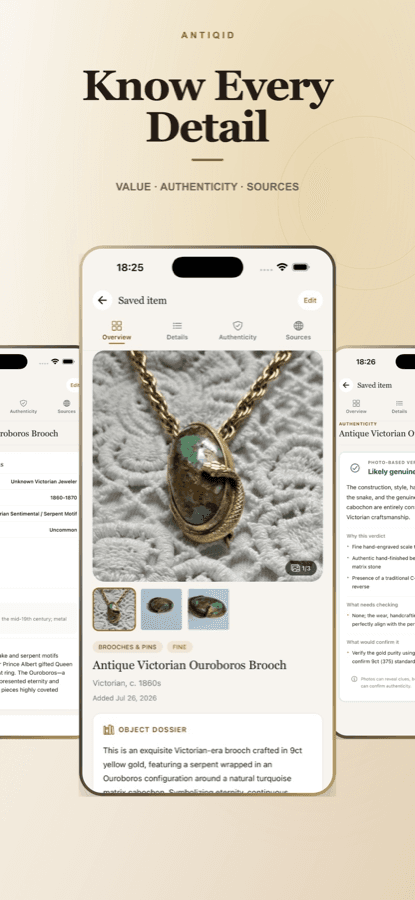
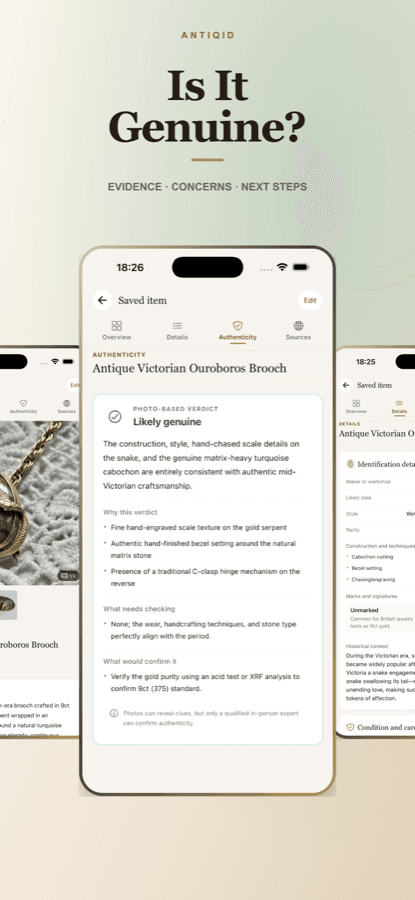
Forensic Era & Maker ID

Pinpoints maker, manufacturing decade, country of origin, and structural materials based on physical evidence.

Forensic Era & Maker ID — AntiqID app

Grounded Resale Ranges

Conservative Fair Market Value ranges drawn from verified secondary market sales—never ungrounded asking prices.

Grounded Resale Ranges — AntiqID app

Honest Confidence Ratings

Clearly explains what evidence is missing and tells you exactly which angle or macro shot will confirm the maker.

Honest Confidence Ratings — AntiqID app

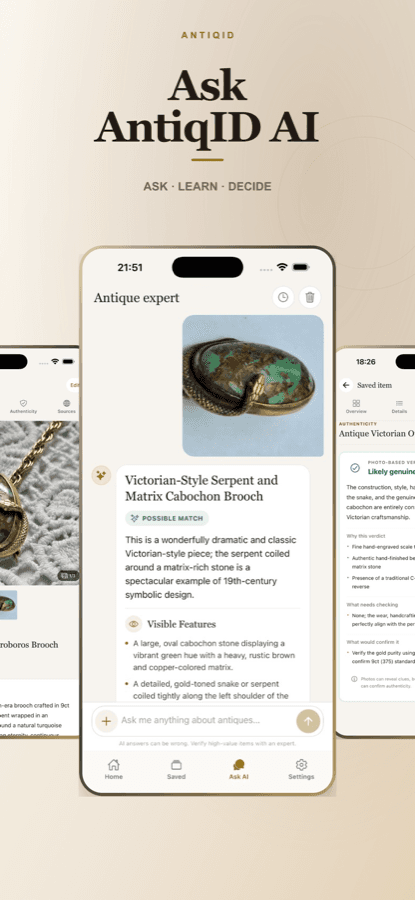
Interactive Ask AI Assistant

Upload follow-up photos to ask about hallmark date letters, gentle conservation advice, or safe appraisal steps.

Interactive Ask AI Assistant — AntiqID app

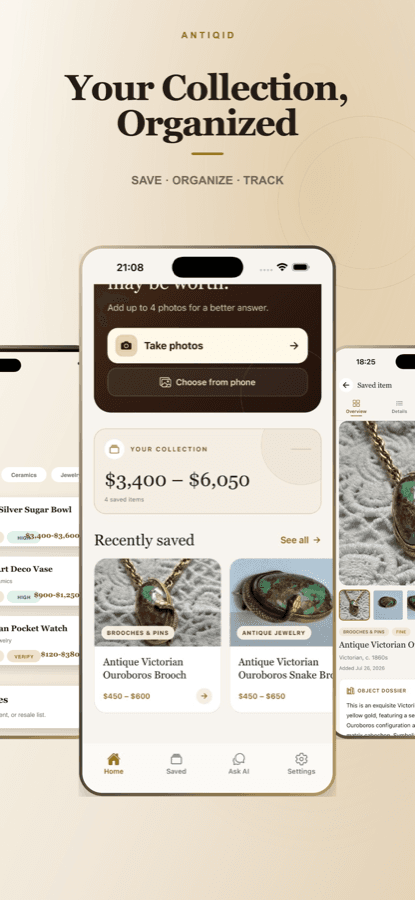
Private On-Device Catalog

Organize your collection into custom albums with purchase prices, estimated values, notes, and exportable CSVs.

Private On-Device Catalog — AntiqID app

Interactive Appraiser Assistant

An antique expert and hallmark database in your pocket.

Have a confusing mark or unusual joinery? Ask follow-up questions in natural language, attach macro photos, and get sourced historical explanations.

  • Ask about maker signatures, date letters, and assay offices
  • Verify wood joinery (hand dovetail vs Knapp pin-and-cove)
  • Receive gentle cleaning advice that preserves natural patina
  • Direct source links to hallmark encyclopedias and museum archives
AntiqID Ask AI chat

Expert Answers

Frequently Asked Questions About Antique Identification & Values

Is AntiqID a certified professional appraisal?+

No. AntiqID provides informational identification, historical context, and estimated Fair Market Value ranges based on comparative sold data. For formal insurance schedules, tax deductions, or legal probate, you should consult an accredited appraiser certified by the ISA, ASA, or AAA.

What is the difference between an asking price and real market value?+

An asking price is simply what a seller hopes to get on platforms like eBay or Etsy; items often sit unsold for years at inflated prices. Real Fair Market Value is determined strictly by completed, verified transaction records where actual cash changed hands between willing buyers and sellers.

How do I take photos that guarantee the most accurate identification?+

Always capture 3 to 4 distinct angles in bright, indirect natural light: (1) The full piece; (2) A crisp, straight-on macro shot of any stamps, hallmarks, or labels; (3) The underside or base showing wear patterns or pontil scars; and (4) Joinery details such as drawer dovetails or hinge screws.

Should I clean or polish my antique before identifying it?+

Never! Aggressive cleaning, polishing silver patina, or stripping furniture varnish can erase up to 80% of an antique's market value in minutes. Original patina is the primary proof of age and authenticity sought by serious collectors.

How does the app date items without visible maker signatures?+

AntiqID analyzes secondary physical clues including country-of-origin customs wording (McKinley Tariff Act 1891), mechanical fastener types (hand-forged nails vs machine screws), drawer dovetail styles (Knapp joints vs hand cuts), and glass pontil scars.

Where is my collection stored? Is my data private?+

Your saved items, photos, personal value logs, and notes are stored 100% locally on your device's private storage. No user account is required, and AntiqID does not maintain a server-side database of your personal collection.

Unlock the Hidden History in Your Home

Turn curious finds into verified knowledge.

Decode marks, verify historical dates, and discover the true secondary market value of any antique—right from your phone.

Get AntiqID

Available on the App Store